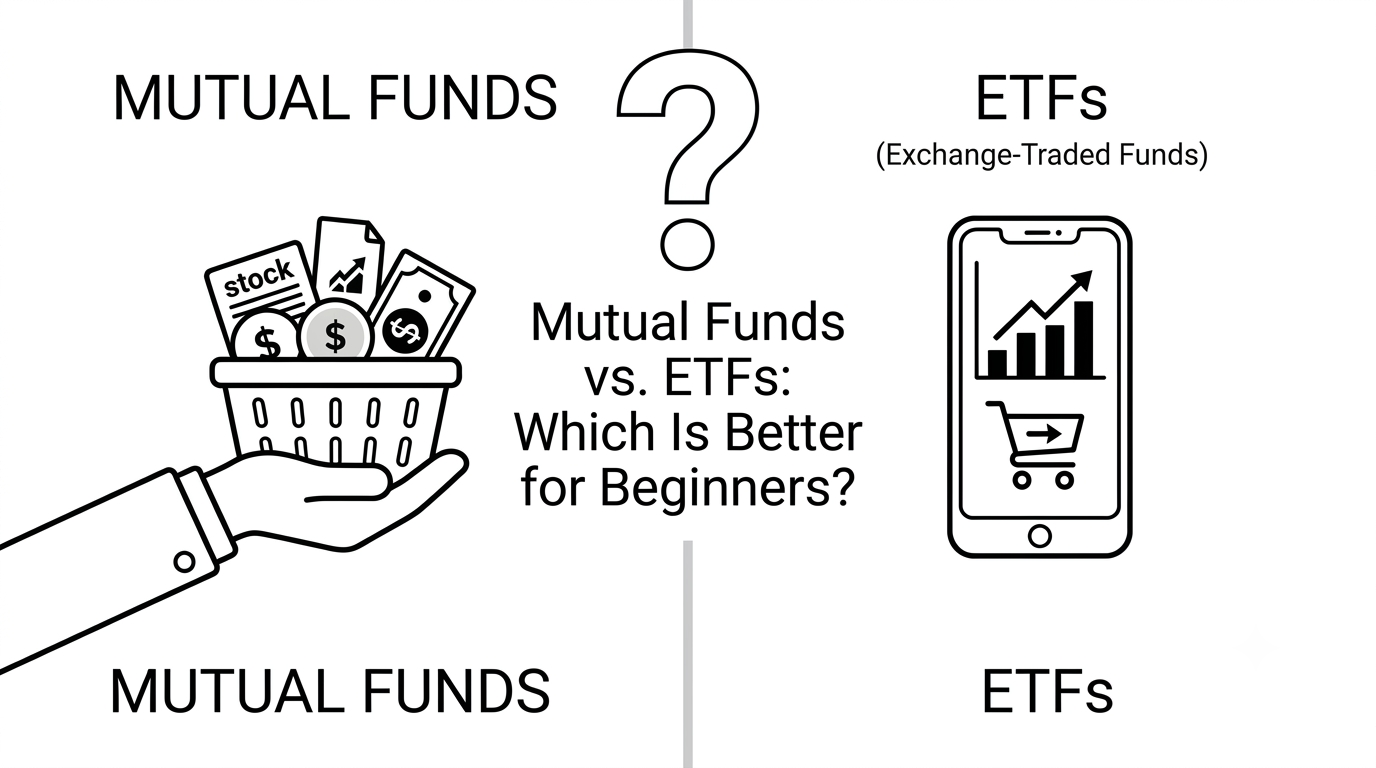
Mutual Funds vs. ETFs: Which Is Better for Beginners?
You have finally decided to invest your hard-earned money. You open a finance app, ready to get started and immediately hit a wall. Mutual fund or ETF? Both sound reasonable. Both promise growth. But which one is actually right for you as a beginner?
This is one of the most common dilemmas for first-time investors, and the good news is there is a clear answer once you understand how each works. In this guide, we break down mutual funds vs. ETFs in plain language, no jargon, no fluff, so you can make a confident decision with your very first investment.
What Is a Mutual Fund?
Think of a mutual fund like a school group project. Everyone in the class contributes money, one smart student (the fund manager) decides how to spend it, and everyone shares the profit or loss at the end. You do not need to know anything about investing. You just show up, contribute, and trust the process.
In real terms, a mutual fund pools money from thousands of investors and a professional fund manager uses that money to buy a diversified mix of stocks, bonds, or both. Your investment grows or falls based on how that portfolio performs.
A simple real-life example:
Imagine Priya is 24 years old and just started her first job. She knows nothing about the stock market but wants to start building wealth. She opens a mutual fund app, sets up a SIP of Rs. 500 per month in a large-cap equity fund, and forgets about it. Every month the money is auto-debited, invested by a professional, and slowly compounded over years. Priya did not pick a single stock. She did not check the market once. And yet her money worked hard in the background.
That is the core appeal of mutual funds for beginners.
Types of mutual funds:
Equity Funds invest in company stocks. Debt Funds invest in government bonds and fixed-income instruments. Hybrid Funds mix both stocks and bonds. Index Funds passively track a market index like the Nifty 50 without active management.
Quick snapshot:
Pros
Cons
No demat account needed
Higher expense ratio for active funds
SIP from as low as Rs. 100
Priced only once per day
Professionally managed
Less control over individual holdings
What Is an ETF?
Now imagine instead of joining the school group project, you go to a shop and buy a ready-made box that already contains 50 of the best performing companies in India. You can buy that box anytime the shop is open, sell it whenever you want, and the price changes throughout the day based on demand.
That box is essentially an ETF.
An ETF (Exchange-Traded Fund) is a basket of securities that trades on a stock exchange just like a regular share. Most ETFs passively track an index such as the Nifty 50 or S&P 500, which means no fund manager is actively picking stocks. This keeps costs low and removes human bias from investment decisions.
A simple real-life example:
Rahul is 27 and has been investing in mutual funds for two years. He now wants to try something with lower fees and more control. He opens a Zerodha account, searches for "Nippon India Nifty 50 ETF," and buys 10 units at the current market price of Rs. 230 each. His total investment is Rs. 2,300. The next day Nifty rises 1.5% and his ETF value goes up accordingly in real time. Rahul can see the price movement live, just like watching a stock. He did not need a fund manager to tell him what happened.
That transparency and real-time control is what makes ETFs attractive to slightly more hands-on investors.
Types of ETFs:
Index ETFs track broad market indices like the Nifty 50 or Sensex. Gold ETFs track the price of physical gold. Sectoral ETFs focus on specific industries like IT, banking, or pharma. International ETFs give you exposure to global markets like the US S&P 500.
Quick snapshot:
Pros
Cons
Lower expense ratio
Requires demat and trading account
Real-time trading flexibility
No automatic SIP on most platforms
Fully transparent daily holdings
Liquidity varies by ETF
Why Should I Buy an ETF Instead of a Mutual Fund?
This is a great question and the honest answer is it depends on what you value most. That said, here are the strongest reasons to choose an ETF over a mutual fund:
1. Lower costs mean more money in your pocket
ETFs typically carry much lower expense ratios than actively managed mutual funds. Here is a simple example to show why this matters.
Suppose you invest Rs. 1,00,000 for 20 years. A mutual fund charging 1.5% annually versus an ETF charging 0.2% annually may seem like a small difference today. But over 20 years, that 1.3% gap can cost you Rs. 30,000 to Rs. 50,000 in lost returns. The lower the fees, the more of your own money stays invested and compounds.
2. No fund manager risk
Most actively managed mutual funds fail to consistently beat their benchmark index over the long run. With an ETF that simply mirrors the index, you stop worrying about whether your fund manager is having a good year or a bad year. You get exactly what the market gives, nothing more, nothing less.
3. You can buy and sell anytime during market hours
A mutual fund is priced once at the end of the day (called NAV). An ETF is priced live throughout the day. So if the market drops sharply at 11am and you want to buy more units at a lower price, an ETF lets you do that. A mutual fund does not.
4. Full transparency every single day
ETFs publish their complete list of holdings every day. With most mutual funds you find out what the manager bought or sold only once a month. If knowing exactly what your money owns matters to you, ETFs are the clear winner.
5. Tax efficiency
Because ETFs do not trade frequently inside the fund, they generate fewer taxable events compared to actively managed mutual funds. This can meaningfully reduce your tax burden year over year.
Bottom line: Choose an ETF if you already have a demat account, want to minimise fees, and are comfortable with index-based investing. If you are a complete beginner who wants automation and simplicity, mutual funds are likely the better starting point.
What Does Warren Buffett Say About ETFs?
When one of the greatest investors in history gives advice, it is worth paying attention. And Warren Buffett has been remarkably consistent on this topic for over three decades.
Buffett has openly endorsed ETFs as an ideal investment for beginners, praising how they provide exposure to a broad range of assets without putting all your eggs in one basket.
His most famous piece of advice on this came from his 2013 Berkshire Hathaway shareholder letter, where he wrote that his advice to his wife's trustee was simple: put 10% of the cash in short-term government bonds and 90% in a very low-cost S&P 500 index fund, specifically suggesting Vanguard's. He believed the trust's long-term results from this policy would be superior to those attained by most investors, whether pension funds, institutions, or individuals, who employ high-fee managers.
At Berkshire's annual meeting in 2021, Buffett told attendees directly: "In my view, for most people, the best thing to do is to own the S&P 500 index fund."
He also confirmed his view to legendary investor John Bogle, stating: "A low-cost index fund is the most sensible equity investment for the great majority of investors."
His entire philosophy rests on three ideas that any beginner can apply:
Diversification. ETFs fit this perfectly by including a wide range of stock types and other assets inside a single investment. Think of it as buying a tiny piece of the 50 or 500 biggest companies in the world with one simple purchase.
Low fees. ETFs that track broad market indexes typically come with significantly lower fees than actively managed funds, and over the long term those savings add directly to your portfolio's value. Buffett famously said that when Wall Street charges high fees, it is usually the managers who get rich, not the investors.
Long-term compounding. Buffett's message has always been consistent: never panic, never stop investing, and let time do the heavy lifting.
Here is a simple example of what Buffett's advice looks like in practice. If you invest Rs. 5,000 per month in a low-cost Nifty 50 ETF starting at age 25 and simply leave it untouched until age 55, assuming a 12% average annual return, you could end up with over Rs. 1.7 crore. No stock picking. No fund manager. Just time and compounding doing their job.
What makes Buffett's endorsement especially striking is that he is himself one of the greatest stock pickers alive. Yet he still tells ordinary investors to skip stock picking and go with a simple index ETF. That says everything.
What Is a Disadvantage of an ETF?
ETFs have many strengths but they are not perfect, especially for absolute beginners. Here are the key drawbacks explained with simple examples:
1. You need a demat account first
Unlike mutual funds where you can invest directly through apps like Groww or Paytm Money with just a PAN card, ETFs require you to open a full brokerage account with a demat facility. For a first-time investor, this extra step can feel overwhelming and time-consuming.
2. No automatic SIP option on most platforms
Here is a practical example. Meera wants to invest Rs. 1,000 every month automatically without thinking about it. With a mutual fund she sets up a SIP once and it runs forever. With an ETF she has to log in manually every month, check the price, and place the order herself. Most people skip this step when life gets busy. That missed discipline can cost years of compounding.
3. Liquidity risk for smaller ETFs
Liquidity risk means a possible difficulty of buying or selling an ETF without significantly impacting its price. Simply put, it is the risk that you may not be able to enter or exit a trade at a fair price.
A simple example: a popular Nifty 50 ETF trades millions of units daily so you can buy and sell instantly at a fair price. But a niche sectoral ETF focused on, say, rural infrastructure might trade only a few thousand units per day. If you need to sell urgently, you may get a worse price than expected.
4. Tracking error
Although rare, tracking errors occur when a fund manager makes investment decisions such as swapping asset classes, which causes the ETF to deviate from the index it is supposed to track.
Think of it this way. If the Nifty 50 index goes up 10% this year but your Nifty 50 ETF only goes up 9.6%, that 0.4% gap is the tracking error. A well-managed ETF keeps this gap very small but it is worth checking before you invest.
5. The temptation to trade too often
Because ETFs trade live like stocks, beginners often make the mistake of watching prices all day and panic-selling the moment the market dips. Key ETF risks include market risk, tracking error, liquidity, sector concentration, and single-stock concentration, and emotional trading amplifies every single one of them.
A mutual fund's once-a-day pricing actually protects beginners from this trap because you simply cannot react to every small market movement.
6. Hidden trading costs
A tight bid-ask spread might be 2 to 3 cents, but for less liquid ETFs it can widen to 10 to 15 cents, shaving off profit each time you trade. These micro-costs are invisible on the surface but they quietly add up over dozens of transactions.
In short: ETFs are excellent tools but they reward patient and informed investors. If you are likely to check your portfolio daily and trade impulsively, a mutual fund's once-a-day pricing and hands-off approach might actually serve you better as a beginner.
Mutual Funds vs. ETFs: Side-by-Side Comparison
Before we tell you which one to pick, let us put everything on one table so you can see the difference at a glance.
Feature
Mutual Fund
ETF
Management Style
Active or Passive
Mostly Passive
How You Buy
App, AMC website, no demat needed
Stock exchange via demat account
Minimum Investment
As low as Rs. 100 via SIP
Price of at least 1 unit
Expense Ratio
Higher for active funds
Generally lower
Pricing
Once per day (end of day NAV)
Live throughout the day
SIP Facility
Yes, fully automatic
Not available on most platforms
Transparency
Monthly portfolio disclosure
Daily holdings disclosure
Tax Efficiency
Lower
Higher
Best For
Beginners, passive investors
Cost-conscious, hands-on investors
ETFs trade throughout the day on exchanges while mutual funds are priced once daily after the market closes, and ETFs use a structure that allows many transactions like rebalancing to take place without triggering taxable capital gains.
Here is a simple way to remember the core difference. A mutual fund is like ordering food from a restaurant. You place your order, the chef (fund manager) prepares it, and you receive your meal at a fixed time. An ETF is like cooking your own meal with a ready-made kit. You buy the ingredients (units) whenever you want, at live market prices, and you are always in control of what is in your plate.
Which Is Better for Beginners? Our Clear Recommendation
There is no single answer that works for everyone but there is a clear framework to guide your decision.
Choose a Mutual Fund if you:
Are investing for the first time and have no demat account. Want to automate your investments through SIP without thinking about it every month. Are investing a small amount like Rs. 100 to Rs. 1,000 per month. Prefer a hands-off approach where someone else manages the portfolio. Get nervous seeing live price movements throughout the day.
A simple example: Anjali is 22, just started earning Rs. 18,000 per month, and wants to save Rs. 500 every month. She has no idea how the stock market works and no time to learn right now. A mutual fund SIP is perfect for her. She sets it up once and lets it run for 10 years without touching it.
Choose an ETF if you:
Already have a demat account through a broker like Zerodha, Groww, or Upstox. Want to keep your investing costs as low as possible over the long term. Are comfortable manually buying units once a month. Prefer tracking exactly what you own every single day. Plan to invest larger amounts where the fee saving becomes significant.
A simple example: Vikram is 30, has been investing for three years, and understands basic market concepts. He wants to shift from a high-fee active mutual fund to something cheaper. He opens a Zerodha account, picks a Nifty 50 ETF with a 0.05% expense ratio, and manually buys units on the first of every month. Over 20 years the fee saving alone could add up to several lakhs.
Mutual funds are well suited for automatic investing and dollar-cost averaging, while in taxable accounts, low-cost index ETFs usually offer lower ongoing costs and better tax efficiency than similar mutual funds for long-term investors.
Can you invest in both?
Absolutely yes. And for many investors, combining both is actually the smartest move.
Here is a practical example. Suppose you invest Rs. 3,000 per month total. You could put Rs. 2,000 in a SIP in an actively managed large-cap mutual fund for professional management, and put Rs. 1,000 in a Nifty 50 ETF every month manually for low-cost index exposure. This way you get the automation of a mutual fund and the cost efficiency of an ETF at the same time. You are not choosing one over the other. You are using both tools for what they are each best at.
Common Beginner Mistakes to Avoid
Whether you choose a mutual fund, an ETF, or both, these are the mistakes that quietly destroy wealth for new investors.
Mistake 1: Chasing last year's top performer
This is the most common beginner trap. You see a mutual fund that gave 45% returns last year and immediately invest in it. But past performance is no guarantee of future results. A fund that did exceptionally well one year often underperforms the next. Always look at 5-year and 10-year track records, not just last year's number.
Mistake 2: Ignoring the expense ratio
Many beginners look only at returns and completely ignore fees. But here is a simple example of why fees matter enormously. Suppose two funds both earn 10% per year before fees. Fund A charges 0.2% and Fund B charges 1.5%. After 25 years on a Rs. 1 lakh investment, Fund A gives you roughly Rs. 9.8 lakh while Fund B gives you only Rs. 7.7 lakh. That 1.3% fee difference silently ate Rs. 2.1 lakh of your wealth.
Mistake 3: Investing without an emergency fund
Before investing a single rupee in mutual funds or ETFs, make sure you have at least 3 to 6 months of expenses saved in a liquid account. Why? Because markets can fall 20 to 30% at any time. If you do not have an emergency fund and suddenly need money, you will be forced to sell your investments at a loss at the worst possible moment.
Mistake 4: Panic selling during a market dip
Imagine you invest Rs. 10,000 in a Nifty 50 ETF in January. By March the market falls 15% and your investment is now worth Rs. 8,500. A beginner panics and sells, locking in a Rs. 1,500 loss. A smart investor sees this as a sale and buys more units at lower prices. ETFs trade throughout the day like stocks, which can be helpful if you want more control over timing and price, but mutual fund orders are executed once per day, all at the same price, which naturally reduces the temptation to react emotionally to every market move.
Mistake 5: Trying to time the market
Many beginners wait for the market to fall before investing. They say things like "I will invest when the market corrects." The problem is nobody knows when that correction will come. You might wait 2 years and miss a 30% rally. The simplest fix is to invest a fixed amount every month regardless of market conditions. This strategy is called rupee cost averaging and it is one of the most powerful habits a beginner can build.
FAQs: Quick Answers for Common Questions
These are the questions people search most often on Google about this topic.
Is an ETF better than a mutual fund for beginners?
It depends on your situation. The right product for a given individual depends on their strategy and risk tolerance. If you are a complete beginner with no demat account who wants to automate savings, a mutual fund is easier to start with. If you already have a brokerage account and want lower fees, an ETF is the smarter long-term choice.
Can I invest in an ETF without a demat account?
No. ETFs are traded on stock exchanges and you need a demat account to buy and hold them. This is different from mutual funds, which can be purchased directly through an AMC or app without any demat account.
Which has lower risk: ETF or mutual fund?
Both carry similar market risk since they invest in similar underlying assets. However, niche or highly specialised ETFs may be harder to sell quickly, while mutual funds operate on a simpler, more structured schedule, which can feel less risky for new investors who are not used to live price movements.
What is the minimum amount to invest in an ETF?
You need to buy at least one unit of an ETF. The price of one unit varies by fund. For example, a Nifty 50 ETF unit might cost Rs. 220 to Rs. 250. Many brokers now offer fractional ETF shares, allowing investors to buy shares of any dollar amount in supported funds, though this feature is not widely available in India yet.
Are ETFs safer than individual stocks?
Yes, significantly safer. When you buy a single stock, all your money is tied to one company. If that company has a bad year, your investment suffers heavily. An ETF spreads your money across 50, 100, or even 500 companies at once. If one company in the ETF performs poorly, the others balance it out. Think of it like this: buying one stock is like betting on one horse in a race. Buying a Nifty 50 ETF is like owning a small piece of all 50 horses at once.
Final Takeaway
Both mutual funds and ETFs are excellent tools for building long-term wealth. Neither is universally better than the other.
If you are just starting out, go with a mutual fund SIP. It is simple, automated, and beginner-friendly. As you learn more about investing and grow your portfolio, you can gradually add ETFs to reduce fees and improve tax efficiency.
The most important thing is not which one you choose. It is that you start. A small, consistent investment today is worth far more than a perfect investment strategy you never actually begin.
Start with Rs. 500 per month. Be consistent. Stay patient. And let compounding do what it does best.
Read next: How to Start Investing with Rs. 1,000 | SIP vs Lumpsum: Which Strategy Is Right for You? | What Is Compound Interest and Why Does It Matter?